Minerals in balance: when less is more
- Sustainable precision farming
Over-supplementing trace minerals can harm cow health, reproduction, and the environment—precision feeding ensures balance, sustainability and profitability.

Minerals are a small but vital component of a ration. Getting the correct overall balance of supplementary minerals is critical to the health, performance and efficiency of a milking herd. Historically, mineral requirement models provide a minimum level required for normal production, and so practical mineral feeding strategies adopt this with an overage above as a safety margin. This approach works well to avoid deficiencies but can pose significant risk of oversupply.
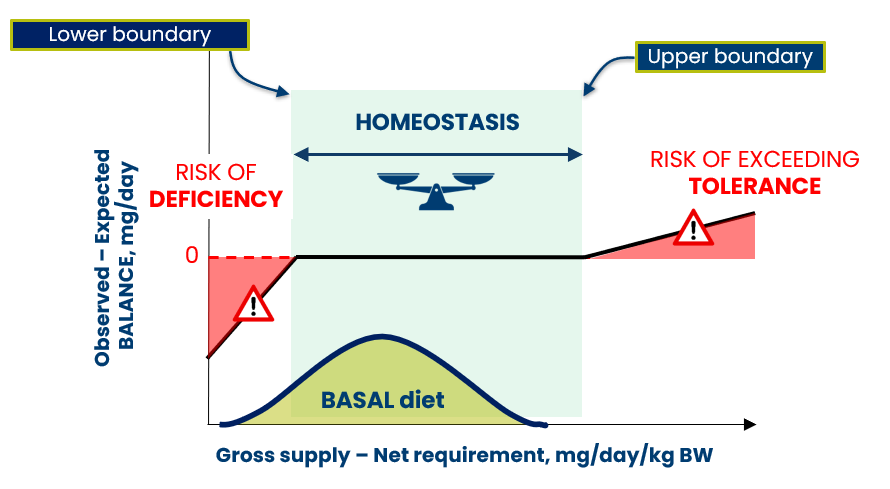
The Trouw Nutrition R&D team have developed a model for defining the minimum and maximum recommended levels of supplemental trace minerals in a diet. Taking into account the diet, forages fed, performance and critically the ability of the animal to up and downregulate absorption based on supply. If a cow is supplemented more, she will absorb proportionately less, and if supplemented less, she will increase absorption to ensure that her needs are met. This model enables increased accuracy of mineral supplementation and optimises supply for health and performance whilst reducing the risk of inefficient and potentially harmful oversupply.
Source: Trouw Nutrition R&D
Read the paper here: Review: Homeostatic boundaries to dietary Zn, Cu and Mn supply in cattle - ScienceDirect
When assessing the mineral supply to your herd, you must consider all aspects of the mineral formulation. Macro-minerals (such as Calcium, Magnesium, Phosphorus and Sodium) typically make up the bulk of a farm mineral.
Undersupplying macro minerals can lead to major health events, such as milk fever, or grass staggers. Conversely, over-supplying macro minerals generally has a lower risk of toxicity, however this doesn’t mean that we should aim to oversupply. Phosphorus, for example, is not stored in the animal, and so excess dietary phosphorus is excreted into the environment. This can cause environmental contamination, and is also costly, with no benefit to the animal.
Trace minerals are also included in mineral supplements, and although required in very small amounts, are vital for health and optimal performance. Read more here about the importance of balancing trace minerals in the ration and the risks associated with oversupply
Click here to learn more about balancing your trace minerals.
 Understand the mineral requirements of your herd
 Determine the level of mineral supply in the basal ration
 Meeting the shortfall with Maxcare farm minerals
Balancing your overall mineral supply and improving the quality of trace mineral sources used can have several benefits for the farm enterprise:
Find out more about Selko IntelliBond hydroxy trace minerals
Click on the  icons below to find out more.


Optimising your mineral supply involves reviewing the source and amounts of minerals provided to your herd. Managing mineral intake carefully helps avoid oversupply, which can lead to increased excretion of minerals into the environment.
Phosphorus is vital for energy metabolism, bone health and many other functions, therefore it is critical that requirements are met. However, excess dietary phosphorus is excreted, and can cause environmental contamination, leading to eutrophication of waterways. Managing the macro-mineral supply to a herd as part of the responsible mineral approach can help to reduce the risk of over-supply.
When looking at the scope 3 emissions of a farm mineral, reformulating to Responsible Mineral guidelines has been shown to reduce the CO2 equivalent emissions, in a worked example the reduction was 89kg CO2 equivalents per tonne - reformulating a basic mineral to improve overall mineral balance and quality of trace mineral sources. Although a small difference, when you multiply this by the mineral use on a farm over a year, and across all herds in a milk supply pool, this can start to add up to a sizable improvement for a mineral formulation update, that requires no change of protocol or system on farm.
Selko IntelliBond was the first improved source of trace mineral nutrition with a Life Cycle Assessment (LCA) that demonstrates a reduction in carbon intensity of milk production, decreasing CO₂ equivalents per kilogram of ECM by 1.5–2.0%.
When planning your on-farm mineral supply, it is important to consider all minerals and vitamins required by the animals, with IntelliBond trace minerals forming one component of the overall mineral strategy.
Optimising your mineral supply starts with reviewing both the sources and levels of minerals provided to your herd. Careful management of mineral intake helps prevent oversupply, which can increase mineral excretion and environmental impact.
Although minerals make up only a small portion of the ration, adjusting the sources and inclusion levels of supplemental minerals can meaningfully reduce farm emissions. Updating your mineral program is a simple, practical step to improve the overall efficiency of your farming system.